


Moisture-resistant laminated panel
30 January 2022
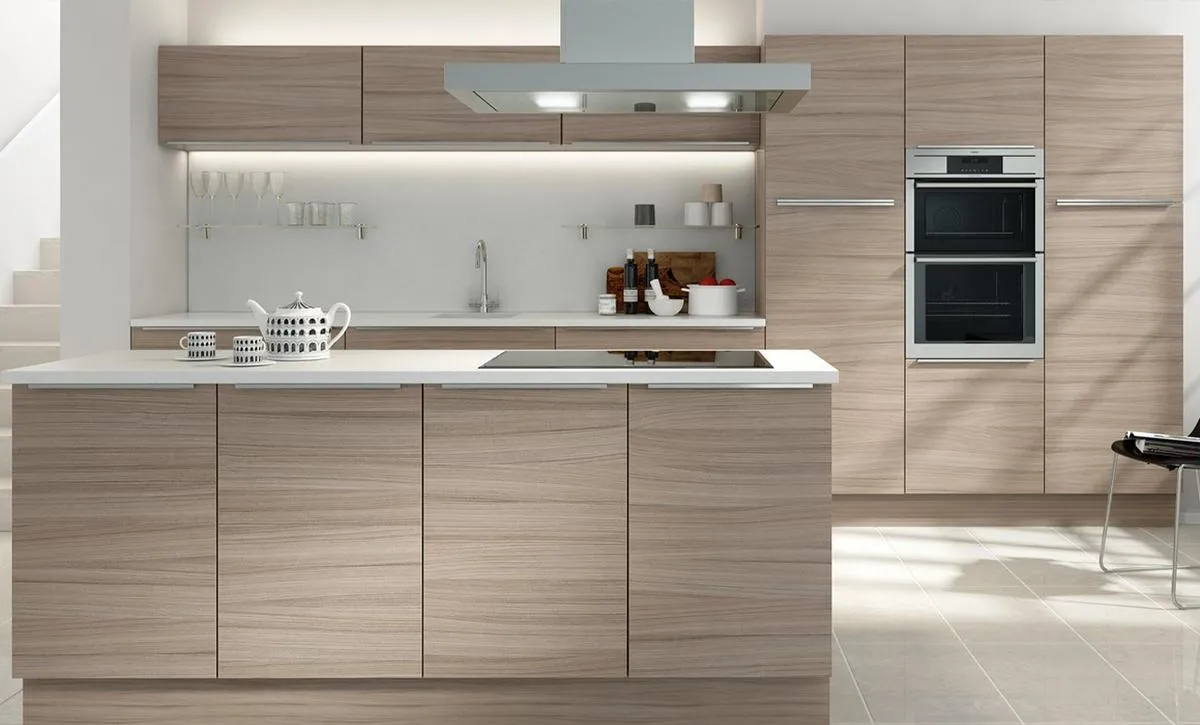
Moisture-resistant laminate panels are ideal for kitchen carcasses — they withstand humidity and don't change colour.
Key Facts
- Moisture-resistance standardfeatures
- EN 312 — P3 (humid conditions), P5 (load-bearing, humid)
- Material typefeatures
- Melamine-faced chipboard (MFC), faced on both sides
- Green corefeatures
- Identification convention, not a waterproofing guarantee
- Continuous heat limitfeatures
- ~50°C per EGGER's recommendation
- Main weak pointother
- Open, un-banded edge — where swelling begins
- Primary usefeatures
- Kitchen furniture carcasses and fronts
Laminated chipboard (melamine-faced board, MFC) is widely used for furniture bodies and fronts — especially in damp zones, in its moisture-resistant version.
How is laminated chipboard made?
Chipboard is made by mixing wood particles (flakes, sawdust) with resin and hot-pressing; it often includes recycled wood. In the melamine-faced version (MFC), decorative paper impregnated with melamine resin is heat-fused to both faces, creating a hard, sealed, decorative surface.
What is the moisture-resistant version?
Moisture-resistant chipboard is defined by the European standard EN 312 (P3 for humid conditions, P5 load-bearing for humid conditions) and uses special water-resistant resins. Its green core is an identification convention, not a guarantee — it is moisture-resistant but not waterproof.
What are the advantages of laminated chipboard?
A hard, coated surface resistant to scratches, wear, stains and heat; easy to clean. A very wide choice of decors (wood, stone, metal looks) and a good price-to-quality ratio — which is why it's the main material for kitchen carcasses.
What should you watch out for?
Cut edges must be properly edge-banded so moisture can't reach the core — swelling starts at open edges. Damaged lamination is essentially unrepairable. Per EGGER, the continuous heat limit is ~50°C.
How to care for it
A soft cloth and a neutral cleaner; avoid abrasives, placing hot cookware directly on it, and letting water pool at the edges.
Futurium and laminated materials
For cabinet bodies we use Austrian EGGER boards — high quality, a broad decor choice and matching edging for every color. For fronts — Italian CLEAF and painted MDF. Our team will help you choose the right material.