



Veneer furniture elements
30 January 2026
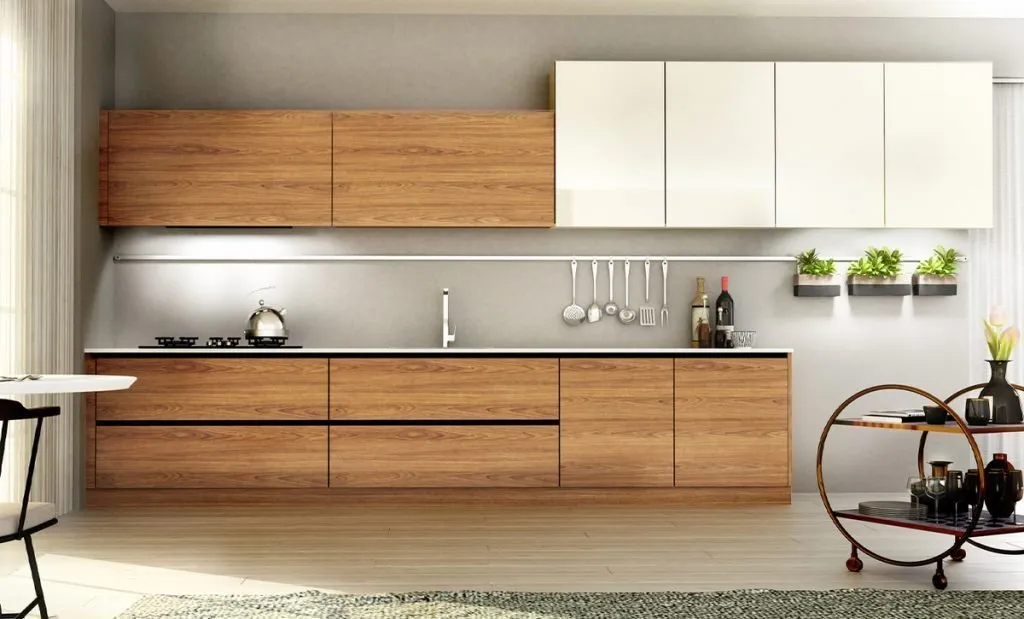
Veneer — the visible texture of natural wood with high quality at an economical price.
Key Facts
- Veneer base materialfeatures
- MDF or plywood
- Cutting methodsfeatures
- Rotary, flat slicing, quarter slicing
- Recommended veneer thickness for cabinet doorsdimensions
- At least ~1.6 mm
- Advantage over solid woodfeatures
- Lighter, more dimensionally stable and more affordable
- Veneer vs laminatefeatures
- Veneer is real wood; laminate is a printed surface
- Weaknessother
- Excess moisture lifts the layer and causes bubbling; sun changes its color
Veneer is a thin layer of natural wood glued onto a base material (MDF or plywood). It gives furniture the aesthetics of real wood at a more accessible price and with better dimensional stability.
What is veneer and how is it made?
Veneer is produced by slicing natural wood into thin sheets. Common methods are: rotary cutting ("peeling") — the most economical; flat slicing — for decorative "cathedral" grain; and quarter slicing — for straight lines. The sheets are glued onto a base. For cabinet doors, veneer is best at least ~1.6 mm thick.
What are the advantages of veneer?
A genuine, real-wood texture — the look depends on the original grain, and no two fronts are alike. Compared with solid wood it is more affordable, lighter and more stable, because the engineered base moves less. Fine scratches can often be buffed out.
What should you watch out for?
The veneer layer is thin — excess moisture can lift it from the base and create "bubbling," and over time direct sun changes its color (as with any natural wood). It is less repairable than solid wood.
Veneer vs solid wood vs printed laminate
Veneer is real wood on a stable base (genuine texture, cheaper than solid). Laminate is a printed/plastic surface that only mimics wood. Veneer has unique, non-repeating natural lines; printed laminate has a repeating pattern.
How to care for veneer fronts
Clean with a soft cloth and a neutral cleaner; avoid abrasives and excess water.
Futurium and veneer
For a natural-wood look we offer veneer fronts, alongside Italian CLEAF and painted MDF options. Our designer-constructor will help you choose the right material.